
GDPR vs. India’s DPDP Act: The Global Privacy Showdown That’s Reshaping AI and SaaS
Understanding the key differences that every AI, SaaS, and data-driven company must know in 2025.

Nandini Mahajan
December 11, 2025
Data privacy isn't just a compliance headache anymore; it's the new battleground for user trust and a major strategic factor for any global business.
In 2018, Europe fired the starting pistol with the General Data Protection Regulation (GDPR), establishing the gold standard for individual data rights. Now, five years later, India, the world's fastest-growing digital economy, has introduced its counter-framework: the Digital Personal Data Protection (DPDP) Act, 2023.
While both laws aim to hand control back to the user, their approaches are fundamentally different. Understanding these subtle shifts isn't just "compliance homework"; it's the difference between scaling successfully and facing crippling fines.
For global SaaS companies, cross-border AI platforms, and product teams, this dual reality is the new normal. Let’s dive deep into the differences, the implications, and why this comparison is making headlines worldwide.
1. The Core Philosophy: Rights-Driven vs. Innovation-Balanced

Designing a Simple Quota System
The first major split is in their DNA.
GDPR (The Rights Champion): This framework is built on the philosophy that privacy is a fundamental human right. It’s comprehensive, often complex, and puts the maximum burden of proof and protection on the organization. Its goal is total protection, often prioritizing the individual over ease of business.
DPDP Act (The Digital Navigator): India’s law is a delicate balancing act. It seeks to empower citizens with essential rights while simultaneously fostering business innovation in its massive tech market. It's deliberately leaner and simpler, aiming to support the growth of startups and the digital economy without the regulatory heaviness of GDPR.
2. The Reach: Data's Definition and the Scope of Control
Where do these laws draw the line on what they govern?
GDPR: The broad net. It covers all personal data, as well a digital and physical records. If you process data of any EU resident, regardless of where your company is based, you are under GDPR jurisdiction.
DPDP Act: The digital focus. It applies only to digital personal data. This focus reflects India's rapid digital transition. It primarily governs data processed within India, simplifying compliance by explicitly excluding physical records unless they are digitized.
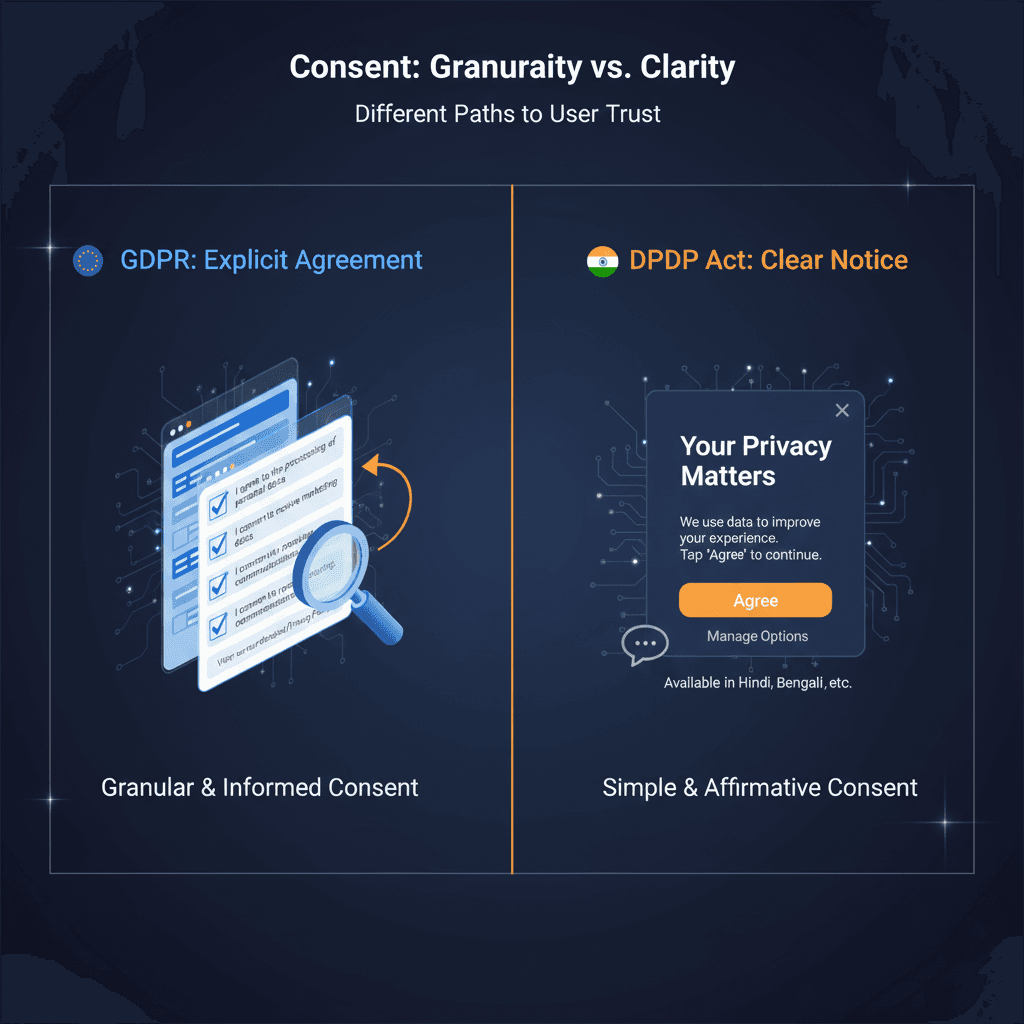
3. Consent: Granularity vs. Clarity
Consent: Granularity vs. Clarity
Consent is the linchpin of both laws, but they handle it with different degrees of intensity.
GDPR (The Explicit Agreement): Consent must be an active, specific, informed, and unambiguous action. This often requires multiple check boxes, detailed privacy notices, and a high bar for documentation. It's designed to prevent passive acceptance.
DPDP Act (The Clear Notice): The Indian law favours simplicity. Consent must be affirmative and voluntary, but the emphasis is on providing a
clear, concise notice (ideally available in multiple local languages). This approach is less documentation-heavy and aims to be more user-friendly, reducing friction for digital services.
4. User Rights: The Extensive Menu vs. The Essential Toolkit
GDPR gives users a powerful suite of controls, while DPDP keeps the toolkit streamlined.
Feature
GDPR (Extensive)
DPDP Act (Essential)
Erasure
Right to be forgotten.
Right to erasure
Access/Correction
Right to access & rectification
Right to access & correction
Control
Right to object, restrict processing, and data portability.
Right to grievance redressal & withdraw consent
Key Takeaway: GDPR's full set of rights means comprehensive system changes for compliance. DPDP provides the core necessary rights but avoids the complexity of mandates like data portability.
5. Penalties: The Global Hammer vs. The Local Wake-Up Call
The financial consequences are staggering, showcasing the seriousness of compliance.
GDPR: The global annual revenue is the scary metric. Fines hit a ceiling of €20 million or 4% of global annual turnover whichever is higher. This is why penalties against tech giants consistently make global news.
DPDP Act: The fines are still serious, reaching up to ₹250 crore (approx. $30 million) per violation. While lower than GDPR’s potential ceiling, this is a massive deterrent, especially for domestic startups, ensuring the law is taken seriously from day one.
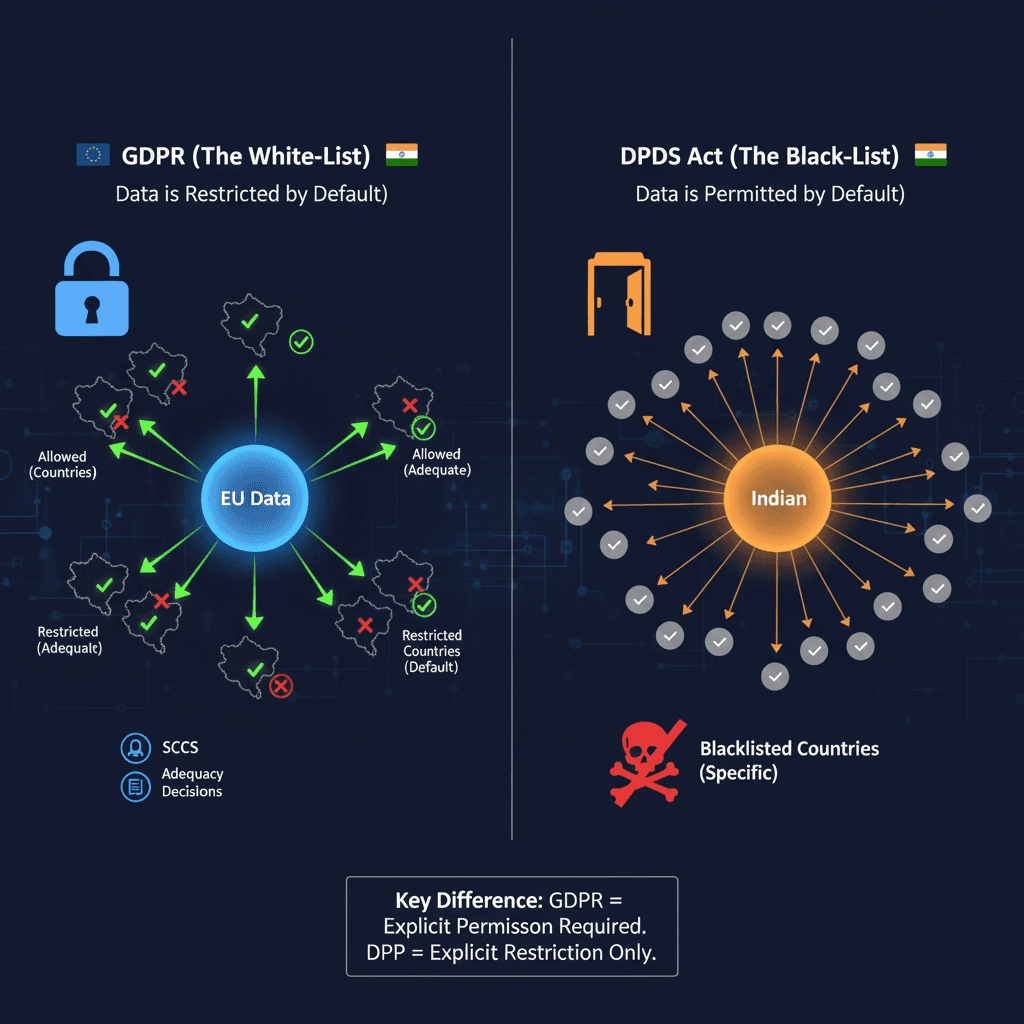
6. Cross-Border Data Transfer: White-List vs. Black-List
Blog 1
This is a critical difference for SaaS and AI companies relying on global infrastructure.
GDPR (The White-List): Data can only flow to countries deemed "adequate" (i.e., having protection standards comparable to the EU) or organizations with approved transfer mechanisms (like SCCs). It assumes data is unsafe until proven safe.
DPDP Act (The Blacklist): India adopts a much simpler approach. Data can be transferred anywhere in the world unless a country is specifically restricted (blacklisted) by the Indian government. This flexibility is a huge win for companies with global deployment models.
7. The Impact on AI and Startups
The laws have different weights for the high-growth sector of AI.
GDPR:Compliance is heavy. AI systems often require detailed Data Protection Impact Assessments (DPIAs), rigid adherence to data minimization, and extensive documentation on algorithmic transparency. This complexity can slow down development cycles.
DPDP Act: For now, the DPDP Act is significantly easier to implement. It is less documentation-heavy and avoids strict pre-deployment mandates on automated decision-making. It’s built to enable quick innovation, but AI teams must be ready for expected sector-specific AI rules down the line.
The Final Verdict: Privacy as a Competitive Edge
The global data privacy map is evolving quickly. With the EU AI Act looming, US federal debates ongoing, and China's PIPL already in place, the world is aligning on the necessity of user protection.
GDPR remains the global heavyweight: comprehensive, rights-driven, and the standard against which all others are measured.
DPDP is the modern blueprint: streamlined, digital-focused, and tailored for a high-growth, innovation-first economy.
For every global team, the message is singular: Privacy is no longer just a legal checkbox; it’s a competitive advantage. Companies that proactively adopt the highest privacy standards (often meaning the GDPR standard) will:
Reduce compliance risk across multiple markets.
Earn user trust instantly, leading to higher engagement.
Innovate Faster by building privacy into the product DNA from the start.
Mastering the differences between the GDPR and the DPDP Act is essential training for the next generation of global product leaders.
Tags
#GDPR#DPDP Act#Data Privacy#Data Protection#Compliance